

Before you start
Before you open the AI settings page, make sure the following items are ready.Setup steps
The setup wizard at the top of the page walks through three steps for connecting and choosing models:1
Configure LLM API
Set up your model connection and complete the initial test.
2
Configure Recommended Models
Choose the recommended models for AI fields and AI automation.
3
Set Chat Model
Choose a model for each of the four chat model tiers.
Configure LLM API
In the Configure LLM API step, click Add LLM provider to add a model provider, then test its models. If you use your own key (BYOK), choose OpenAI Compatible or Anthropic as the provider type.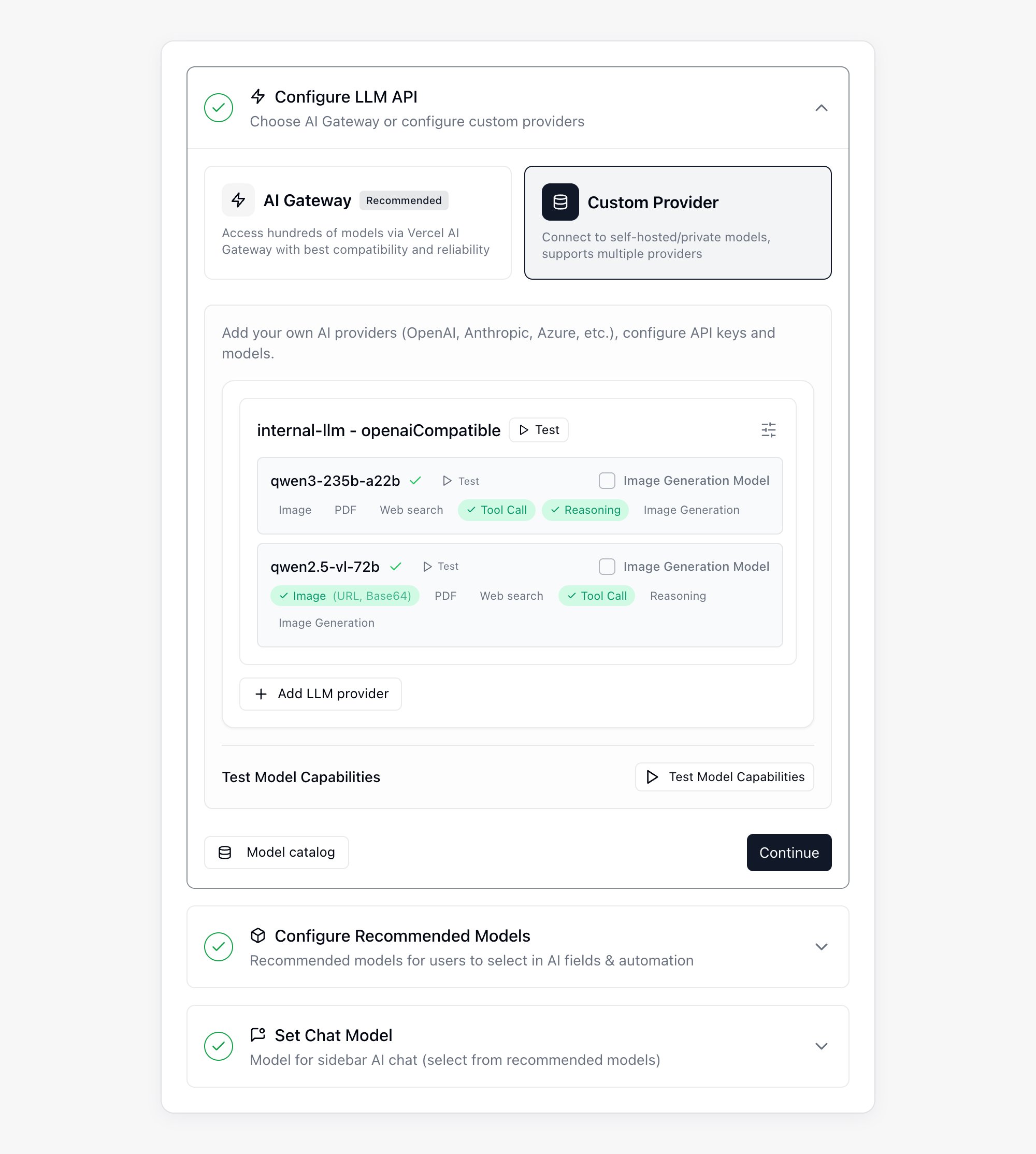
Configure Recommended Models
Choose the recommended models users can select in AI fields and AI automation.Set Chat Model
In Chat model tiers, pick a model for Ultra, Smart, Standard, and Lite; the models you can pick are the recommended models from step 2, Configure Recommended Models. Users choose by tier in the model menu of sidebar AI Chat and see the tier name rather than the model name, so you can swap the model behind a tier at any time without affecting anyone who already picked it.
Each tier has two more controls on its right:
- Set as default: the tier users land on when they open the model menu. An Ultra with no model cannot be the default.
- Enabled: turn it off and the tier is no longer offered to users. The default tier cannot be turned off.
Configure the runtime
The runtime is configured in the AI Chat Runtime card below the wizard. After the deployment is complete, click Run test to verify the AI Chat runtime.Enable AI features
In AI Capabilities, enable AI Field and AI Chat as needed. Configure the runtime before using AI Chat.Configure App Builder
In Deployment Engine, choose how apps are deployed:
You can add these optional App Builder settings when needed:
In App Auth, you can configure sign-in providers for generated apps:
- Email OTP uses an independent SMTP mailbox for app login verification emails.
- Google OAuth requires a Client ID and Client Secret. Add the redirect URI shown on this page to the authorized redirect URI list in Google Cloud Console.
Optional. Configure Voice input
To use voice input in AI Chat, enable the feature and enter an OpenAI API Key. Configure the Transcription Endpoint only when using a custom transcription service. You can also limit the recording length and requests per minute.Verify the setup
After the setup is done, first confirm that all required items in the Pending configuration panel are green. Then test AI Chat, AI fields, AI automation, and App Builder one by one.FAQ
I get a credit exceeded error
I get a credit exceeded error
Check the account or provider used by your configured model service. Top up or change the model configuration if needed.